
Age
Mainly designed for children aged 3–12. Readiness and individual eye conditions matter.
Amblyopia · Strabismus · Visual Function Training
Evidence-informed visual training designed to support children under professional guidance, with home-based digital exercises and progress tracking.
Send us your child's recent eye examination report and we will help you understand the key information for free.
Send it to us and get a free explanation. A clearer understanding is a good first step.
This service helps parents understand information in existing eye examination reports. It does not provide diagnosis or replace evaluation by a qualified ophthalmologist.
Start with your child, their examination results, and professional guidance.
Mainly designed for children aged 3–12. Readiness and individual eye conditions matter.
Prepare visual acuity, refraction, corrected vision, fundus findings and existing medical advice.
A professional should assess suitability. If fundus results are missing, unclear or abnormal, see an ophthalmologist first.
Amblyopia management starts with an eye examination. Glasses and, when prescribed, patching help the weaker eye participate. Software offers structured tasks within an individually agreed plan.
Visual training does not replace professional eye examinations, glasses or physician-prescribed occlusion. Software training time is not patching time.
| Approach | What parents do | Advantages | Things to consider | Progress evaluation |
|---|---|---|---|---|
| Glasses + observation | Use prescribed glasses; attend reviews | Simple daily routine | Observation needs a medical plan | Eye examination |
| Doctor-guided occlusion | Patch the prescribed eye for the prescribed time | Established clinical approach | Do not change the eye or duration yourself | Corrected vision and binocular tests |
| Occlusion + device training | Follow the prescribed device and patching plan | Supervised device tasks may be available | Check the exact device and qualification | Clinical review |
| Occlusion + software training | Complete assigned tasks; keep records | Home access and recorded tasks | Suitability and product evidence matter | Training records + eye examination |
| No examination / no plan | No structured assessment | No training cost | May delay appropriate care; not advised | Arrange an eye examination |
How Training Works
Share recent results and existing medical advice.
Choose suitable tasks with professional guidance.
Follow the tasks assigned to your child’s account.
Keep completion notes and any signs of discomfort.
Bring records to the next eye examination.
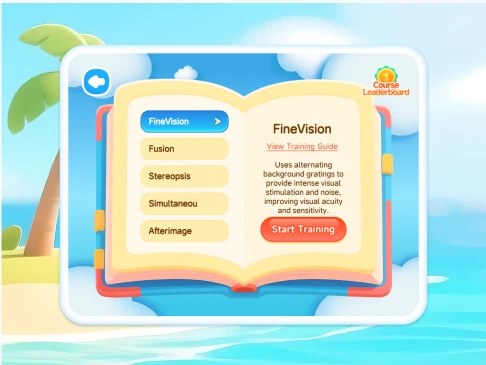
A real screen from the Simingtang training software
Explore the available trial tasks together. Watch whether your child understands the game, can complete it and feels comfortable. A trial assesses acceptance, not eventual treatment results.
Tablet for younger children; computer or tablet for confident users. A phone can be used when needed. The child should see clearly and operate comfortably.
Around once a day is a general reference. Your child’s plan may be shorter, split into sessions or adjusted. Never force a child to finish.
Bring previous results and training records. Seek an earlier review for declining vision, persistent discomfort or lack of progress. Follow your doctor’s schedule.
Make an informed decision with a clear view of what is available. The current materials include historical cases, research cooperation images and a parent guide. A complete product-specific clinical study report has not been provided.
Cooperation materials and individual accounts do not establish a clinical success rate. No guaranteed outcomes are stated.
Medical Certification
The supplied historical image shows a Chinese Medical Institution Practice License. This is an institution license; it does not establish medical device registration for this software.
See the original image for details. Registration text is not transcribed where it cannot be reliably read.
China Central Television (中国中央电视台)
A historical interview cover featuring Simingtang’s founder and host Dong Qian, discussing children’s eye health.
Interview cover from the supplied archive. The video has not been supplied.
Explore the software’s training categories. The right selection depends on professional assessment.
Structured visual tasks selected around corrected vision and the agreed plan.
Visual training does not replace professional eye examinations, glasses or physician-prescribed occlusion. Software training time is not patching time.
Profiles below are reproduced from the supplied historical materials. Roles and affiliations are stated as recorded in those materials.

Chief physician · Professor
Shanghai Eye & ENT Hospital · Grade III-A
Diagnosis and treatment of glaucoma, optic nerve disorders and low intraocular pressure, particularly combined medical and surgical management of refractory glaucoma.

Chief physician · Professor
Shanghai Longhua Hospital · Grade III-A
Ophthalmic procedures including strabismus and amblyopia correction and glaucoma surgery; integrated Chinese and Western medicine for keratitis, dry eye and fundus disorders.

Chief physician · Professor
Shanghai Eye & ENT Hospital · Grade III-A
Minimally invasive, precise treatment of common forms of strabismus with a focus on lasting outcomes; amblyopia treatment and refractive correction; clinical and genetic diagnosis and counseling for complex inherited fundus disorders.
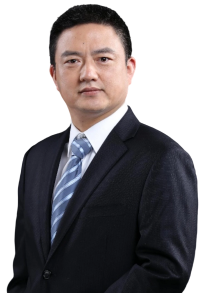
Chief physician · Associate professor
Shanghai Renji Hospital · Grade III-A
Diagnosis and treatment of different forms of strabismus; individualized amblyopia treatment; correction of refractive errors, including excimer laser correction; and diagnosis and treatment of ocular surface disorders.

Chief physician
Shanghai Eye & ENT Hospital · Grade III-A
Diagnosis and surgical treatment of strabismus; investigation of causes and personalized treatment of amblyopia and double vision; and prevention and control of childhood myopia.

Chief physician
Shanghai Eye Disease Prevention and Treatment Center · Grade III-A
Optometry, including childhood myopia prevention and control, strabismus and amblyopia care, contact lens fitting, visual fatigue and visual rehabilitation, as well as refractive surgery.
Historical materials describe technical cooperation with Shanghai Jiao Tong University and project cooperation with the Shanghai Association of Integrated Traditional and Western Medicine.
Anonymized summaries of historical individual accounts. Individual results vary; these accounts do not predict your child’s outcome.
Source: supplied historical case image. Decimal acuity notation retained; these are not controlled study results.
Amblyopia Training & Matching Gratings · reference plans from the supplied software store image.
Prices are based in CNY. Approximate USD amounts use a fixed reference of USD 1 = CNY 7.00 and are not live exchange rates. Final prices and payment currency are shown in the software store.
Purchase inside the software using the same account you will train with. Review access time, task coverage, guidance and refund terms before paying.
You can request a refund based on your unused quota, after deducting taxes and fees.
Ask about a refundFrequently Asked Questions
Not sure how to read the report?
Free Vision Report AnalysisThis service helps parents understand information in existing eye examination reports. It does not provide diagnosis or replace evaluation by a qualified ophthalmologist.
Mainly for children aged 3–12 following an eye examination and professional assessment. Missing or abnormal fundus findings need an ophthalmologist’s review before purchase.
Yes. Send the existing report via WhatsApp for a free explanation of key information and questions to discuss with your doctor.
Recent visual acuity, refraction, corrected visual acuity, fundus findings, binocular function results and your doctor’s diagnosis or recommendations.
Yes. Use +86 188 6816 2397. You can remove unnecessary identifying information before sending and should share only reports you are authorized to share.
No. It explains existing information and does not diagnose, prescribe or replace an ophthalmologist’s evaluation.
Yes, try the available trial tasks with your child. The trial helps assess understanding, willingness and comfort; it cannot establish treatment effectiveness.
Complete the tasks assigned in the child’s account. Keep records, follow demonstrations and ask for guidance if a task is unclear. Do not add tasks or intensity yourself.
Only an ophthalmologist should decide which eye needs patching and for how long. Software session length is different from patching duration. Keep wearing prescribed glasses.
A general reference is around once a day for about 30 minutes. Individual plans vary, may be shorter or divided into sessions, and should change according to professional advice.
The guide describes phones, tablets and computers. Tablets can be easier for younger children. Ask for current supported operating systems and official installation instructions.
Around every three months, or sooner when your doctor advises. Bring the previous examination and training records.
Stop the task. Record the symptoms and activity. Persistent discomfort, reduced vision or lack of progress calls for professional reassessment; do not force completion.
Install the software, register and sign in, open Software Store, then choose and pay for a plan. Check terms before payment and use the same account afterward.
Yes. You can request a refund based on your unused quota, after deducting taxes and fees.

Send us the latest eye examination report. We will help you understand the key information for free.
This service helps parents understand information in existing eye examination reports. It does not provide diagnosis or replace evaluation by a qualified ophthalmologist.